Showing posts with label government. Show all posts

Wednesday, January 7, 2009

And Over the Bridge From Flushing to the Capitol Hill Door

Give It to The Nanny: Why Drescher Is Better Than Kennedy

So it looks like Irish bootlegging scion Caroline Kennedy might have this New York Senate appointment all wrapped up. If you've been paying attention at all, you know this is a disaster, primarily because the only political thing Caroline Kennedy’s ever done is be conceived by one of America’s most beloved presidents.

With Kennedy as the probable pick, other Senate hopefuls must be dejected, none more than former The Nanny star Fran Drescher, who’d thrown her unlikely hat into the ring early last month. We're a bit disappointed, too. Franny may not have been more qualified than Andrew Cuomo, but she's definitely as, if not more, qualified than Kennedy. Don't believe us? Let us count the ways.

She beat cancer
In 2000, Drescher was diagnosed with uterine cancer, which she eventually overcame and wrote about in her second bestseller Cancer Schmancer. One of the most important problems the government is going to have to address in the coming years is the health care dilemma. Who better to help broach this insanely complicated policy question than someone who’s traversed the Byzantine American medical system herself?

She’s a female celebrity, too
Not that that should matter, but some people are saying that Hillary’s replacement should also be a well-known woman, so we’re just putting it out there.

She's familiar with the criminal justice system
No stranger to hardship, years before she was afflicted by cancer, Drescher was raped at gunpoint in her Los Angeles apartment. Hurt but unwilling to shrink from fear, Drescher pressed charges and eventually saw her attacker go to prison. Despite having a law degree, the never-practicing Caroline Kennedy's not once seen the inside of a courtroom. Drescher, on the other hand, has been in the thick of American criminal justice and could address the system's woes from a fresh perspective.

She's written two books
Not sure why, but Caroline Kennedy mentions the fact that she's written books whenever she's asked about her political qualifications. Fran Drescher's not written as many books as Kennedy, but she's authored two huge hits. So there's that.

She started two nonprofits
After beating cancer, Drescher founded two nonprofit organizations dedicated to helping other women diagnose cancer in stage one, when it is most susceptible to treatment. She's now president of the boards of both, where she works in conjunction with a famous honorary board member you've perhaps heard of: Hillary Rodham Clinton.

She's a born and raised New Yorker
Unlike Caroline Kennedy, who bounced around quite frequently after being born in New York, Fran Drescher was born in Queens and stayed there until her early 20s. After spending some time in LA, Drescher moved back to New York and has been here since. As for Kennedy, although she's now resided in New York for quite some time, she hasn't lived anywhere besides the luxurious Upper East Side, a locale both geographically and financially far away from the real ills of New York. Never trust a New Yorker who's never seen a man shitting in the street.

Wednesday, December 10, 2008

Who Said What?

It's time to play Name That Goon! Rod Blagojevich vs. Tony Soprano.

Hands on buzzers: One's a trash-talking thug trying to stay one step ahead of the law. The other was played by James Gandolfini. Can you identify the speaker of the ten quotes below?

1. "Unless I get something real good...shit, I'll just send myself, you know what I'm saying."

2. "What the fuck am I, a toxic person or something?"

3. "Log off, that "cookies" shit makes me nervous!"

4. "They're not willing to give me anything except appreciation. Fuck them."

5. "You got no fuckin' idea what it's like to be number one. Every decision you make affects every facet of every other fucking thing."

6. "I've got this thing and it’s fucking golden, and I'm just not giving it up for fuckin' nothing. I'm not gonna do it. And I can always use it. I can parachute me there."

7. "That motherfucker's full of shit. He's shaking me down."

8. "Our recommendation is fire all those fucking people, get 'em the fuck out of there..."

9. "I could have made a larger announcement but wanted to see how they perform by the end of the year. If they don't perform, fuck 'em."

10. "Jesus Christ! The money I've been dropping in here, I could've bought a fuckin' Ferrari."

Answers:
Tony Soprano: 2, 3, 5, 7, 10
Governor Blagojevich: 1, 4, 6, 8, 9

Monday, November 17, 2008

Power Up!


Ready to be nostalgic for November 3? Super Obama World is a simple Flash-based Mario Bros clone that pits our hero against lipstick-wearing pigs and other campaign detritus. Reasonably fun, but overwhelmed with invasive ads. Super Obama World (viaTokyomango)

Thursday, November 6, 2008

Thank You Captain Obvious

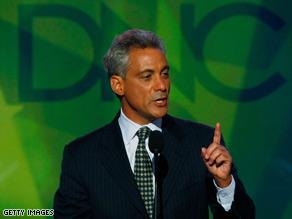
I could have told you Rep. Rahm Emanuel would be Chief of Staff... this is no big shocker to Chez Copa, CNN.

Emanuel pick gets mixed reaction

  • Story Highlights
  • Rep. Rahm Emanuel has a reputation as a tough political infighter
  • Boehner leader calls Emanuel an "ironic choice" for Obama
  • Reid's communications adviser says Rahm is a "brilliant strategic thinker"
  • Political analyst Gergen says they're "setting up a good cop/bad cop routine"

(CNN) -- President-elect Barack Obama's first major appointment received mixed reaction from Democrats and Republicans.

Rep. Rahm Emanuel on Thursday accepted Obama's offer to be White House chief of staff.

The Office of the Chief of Staff oversees and coordinates activities and communication among various departments of the administration. It is considered one of the top positions in Washington.

Some party leaders hailed Obama's pick, but others expressed concern that Emanuel would widen Washington's partisan divide. Watch what Emanuel says about being considered for the job

Jim Manley, the senior communications adviser for Senate Majority Leader Harry Reid, said Emanuel is "an excellent choice."

"Rahm knows the Hill, and he knows the White House. He is a brilliant strategic thinker and someone who knows how to get things done."

Manley said allegations that Emanuel is a true partisan are "ridiculous."

"Rahm understands politics is the art of compromise. He's got a deeply held set of views, but he also understands to get things done you have to compromise," he said.

But House Minority Leader John Boehner questioned Obama's selection.

"This is an ironic choice for a president-elect who has promised to change Washington, make politics more civil and govern from the center," he said in a statement.

A senior Democratic congressional aide also shook his head at the notion of Emanuel becoming the gatekeeper for Obama. The aide said that Emanuel's abrasive approach is "off-putting" and that his style runs counter to Obama's promise of a post-partisan administration.

"It contradicts what is his stated style goal of governance," the aide said.

In his statement accepting the position, Emanuel directly addressed Republicans who might have concerns with his appointment.

"We often disagree, but I respect their motives. Now is a time for unity, and Mr. President-elect, I will do everything in my power to help you stitch together the frayed fabric of our politics and help summon Americans of both parties to unite in common purpose," he said.

Emanuel, who has a reputation as a tough political infighter, is credited with helping Democrats take control of the House in 2006.

The Chicago politician was elected to the House in 2002 and is the fourth highest-ranking member of the chamber's Democratic leadership. He worked on President Clinton's first presidential campaign and served as a White House adviser to Clinton. VideoWatch more on Rahm Emanuel »

Emanuel choked up as he said how glad he is his parents are alive to see him become chief of staff for the first African-American president.

Democratic Sen. Chris Dodd said he thinks Emanuel is a "great choice."

"I know that he and Barack Obama have a very good relationship going back a long time. So it touches all of the critical elements, it seems to me, in beginning that kind of transition we'd like to have. So I think it's a great choice, and I think the president-elect will be well-served with Rahm Emanuel," he said.

Republican Lindsey Graham sided with Dodd and called Emanuel a "wise choice."

"Rahm knows Capitol Hill and has great political skills. He can be a tough partisan but also understands the need to work together. He is well-suited for the position of White House chief of staff," the South Carolina senator said.

Graham said he and Emanuel worked together during the presidential debate negotiations, and "when we hit a rough spot, he always looked for a path forward."

Rep. John Larson, vice chairman of the House Democratic Caucus, said he looked forward to working with Emanuel.

"I would first like to congratulate my colleague and friend Rahm Emanuel on his new position in the Obama administration. I know the Obama administration will be well-served by his skills and acumen. I look forward to working with him on the president's agenda for the country," he said in a statement.

David Gergen, a CNN senior political analyst who has worked in five administrations, said the contrasting styles between Obama and Emanuel could help the new president get things done in Washington.

"They are obviously setting up a good cop/bad cop routine in the White House. ... Barack Obama can be the good guy," Gergen said.

At a news conference Friday, Obama is expected to take questions and talk about his first steps as president-elect.


Thursday, October 16, 2008

You, Ma'am, Are No Margaret Thatcher

Take that, bitch!

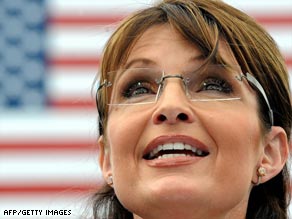
Europe mocks 'half-baked Alaskan' Palin

LONDON, England (CNN) -- There's no doubt about it. The European media has given Sarah Palin a hard time.
One European newspaper called the idea of a Palin presidency a "half-baked Alaskan nightmare."

One European newspaper called the idea of a Palin presidency a "half-baked Alaskan nightmare."

Things started quite well, with the curiosity factor. To many Europeans there is something exotic about snowy Alaska. Viewers and readers were intrigued by the shots of the outdoorswoman with her eyes squinting fixed along a gun barrel, the thought of a vice president who had once been a beauty queen.

Columnists were approving that here, for once, was a politician in the higher reaches who probably actually knew the price of a loaf and a pint of milk. Women writers in particular responded warmly to her joke about the difference between a pitbull and a hockey mom --"Lipstick."

But soon the carping began, and it was not confined to what U.S. rightists like to dismiss as the "liberal media elite."

We were, the Irish Times warned, "just a heartbeat away from the biggest half-baked Alaskan nightmare." Britain's Financial Times said his selection of vice president raised serious questions about John McCain's judgment and added: "The Palin appointment is yet more proof of the way that abortion still dominates American politics."

Prominence was given to an onslaught on Palin's environmental and animal rights record by veteran ex-film star Brigitte Bardot. Spain's left wing El Pais described Palin as "a figure who comes from the America that is farthest removed from and incomprehensible to the European spectator."

Since then the scorn has been constant, the jokes unrelenting, the YouTube exposure devastating. But let us dispel one bit of nonsense from the start. It is nothing to do with Sarah Palin being of the feminine gender.Sound Off: Is it fair for Europeans to criticize Sarah Palin?

Europeans have been astonished that America has never had a woman president. After all we in Britain elected the redoubtable Margaret Thatcher three times as prime minister. Norway did the same with Gro Harlem Brundtland. Germany has a female chancellor, Angela Merkel, even if she does tend to underline the remark I once heard from a British Ambassador: "A German joke is no laughing matter."

Nicolas Sarkozy's socialist challenger for the French presidency was the elegant Segolene Royal.

When Sarah Palin first became McCain's running mate there were even headlines in some British media suggesting that America had found its own Margaret Thatcher.

That certainly was overdoing it. So much so that after 20 years close up reporting on the original I can't resist the temptation to paraphrase Lloyd Bentsen's comment when Dan Quayle unwisely compared himself to John F. Kennedy. "I've interviewed Margaret Thatcher, Governor Palin and I can tell you that you are no Margaret Thatcher."

No, the problem for Sarah Palin in terms of her acceptance in Europe has been the deep wave of Obamamania that had already swept through the European media before her appointment, the self-inflicted wounds of her early media appearances and the apparent box-ticking cynicism of her choice.

That was summed up for some by the appearance of those women at McCain rallies wearing T-shirts emblazoned "Small Town Gun-Totin Christians for McCain."

For Europeans, who were alienated during George W. Bush's first four years by a president who showed little interest in their continent and patently cared nothing for the opinions of its leaders, the turning point probably came with the appearance on the Katie Couric show when Palin confessed to not having had a passport until 2006.

Europeans are appalled at the thought that someone who wants to be vice president of the most powerful nation on earth had so little interest in the rest of a world which is so vitally affected by the decisions of the man, or woman, in the White House. iReport: Why are the 2008 U.S. Elections important to you and your home country?

And they are not much impressed by explanations that her parents did not have the money to send her on a fact-finding tour of the world as a student. Anybody with the money to own an SUV, hunt moose and drive a snowmobile has the money to travel.

It was the American Mark Twain who reminded us all that "travel is fatal to prejudice, bigotry and narrow-mindedness." If Sarah Palin wanted to be loved in Europe she should have got about a bit.


Sunday, September 21, 2008

This Just In: All Bullies Ordered to Back Off Palin in the Schoolyard

What a bunch of bullshit. Palin, why don't you grow a pair and step up. If you really want to be Vice President of the most powerful country in the world, perhaps you should have a little debate experience... and if you don't, then perhaps this job isn't for you.

September 21, 2008

Pact on Debates Will Let McCain and Obama Spar

The Obama and McCain campaigns have agreed to an unusual free-flowing format for the three televised presidential debates, which begin Friday, but the McCain camp fought for and won a much more structured approach for the questioning at the vice-presidential debate, advisers to both campaigns said Saturday.

At the insistence of the McCain campaign, the Oct. 2 debate between the Republican nominee for vice president, Gov. Sarah Palin, and her Democratic rival, Senator Joseph R. Biden Jr., will have shorter question-and-answer segments than those for the presidential nominees, the advisers said. There will also be much less opportunity for free-wheeling, direct exchanges between the running mates.

McCain advisers said they had been concerned that a loose format could leave Ms. Palin, a relatively inexperienced debater, at a disadvantage and largely on the defensive.

The wrangling was chiefly between the McCain-Palin camp and the nonpartisan Commission on Presidential Debates, which is sponsoring the forums.

Commission members wanted a relaxed format that included time for unpredictable questioning and challenges between the two vice-presidential candidates. On Wednesday, the commission unanimously rejected a proposal sought by advisers to Ms. Palin and Senator John McCain of Arizona, the Republican presidential nominee, to have the moderator ask questions and the candidates answer, with no time for unfettered exchanges. Advisers to Mr. Biden say they were comfortable with either format.

Both campaigns see the four debates as pivotal moments in a presidential race that is not only extraordinarily close but also drawing intense interest from voters; roughly 40 million viewers watched the major speeches at the two parties’ conventions. The upheaval in the financial markets has recast the race in recent days, moreover, which both sides believe will only heighten attention for the debates.

A commission member said that the new agreement on the vice-presidential debate was reached late Saturday morning. It calls for shorter blocks of candidate statements and open discussion than at the presidential debates.

McCain advisers said they were only somewhat concerned about Ms. Palin’s debating skills compared with those of Mr. Biden, who has served six terms in the Senate, or about his chances of tripping her up. Instead, they say, they wanted Ms. Palin to have opportunities to present Mr. McCain’s positions, rather than spending time talking about her experience or playing defense.

While the debates between presidential nominees are traditionally the main events in the fall election season, the public interest in Ms. Palin has proved extraordinary, and a large audience is expected for her national debate debut.

Indeed, both the McCain and Obama campaigns have similar concerns about the vice-presidential matchup in St. Louis: that Ms. Palin, of Alaska, as a new player in national politics, or Mr. Biden, of Delaware, as a loquacious and gaffe-prone speaker, could commit a momentum-changing misstep in their debate.

The negotiations for the three 90-minute debates between the men at the top of the tickets were largely free of brinksmanship. Neither side threatened to pull out, and concerns about camera angles and stagecraft were minor.

Senator Barack Obama of Illinois, the Democratic nominee for president, and Mr. McCain did not intercede personally to settle any disputes. They agreed to one substantive change to the format originally proposed by the debate commission, giving them two minutes apiece to make a statement at the beginning of each segment on a new topic.

Mr. Obama successfully sought to flip the proposed topics for the first and third debates, so foreign policy is now coming first and economic and other domestic issues come last. There is a second debate, in the format of a town hall meeting, in which the candidates will sit on director’s chairs and take questions from the audience and Internet users on any topic.

The debate commission had proposed that the first debate be on economic issues and the third on foreign policy — in part, people involved in the process said, because the first debate is usually the most watched, and many voters rank the economy as their top concern.

Mr. Obama wanted foreign policy first to show viewers that he could provide depth, strength and intelligence on those issues, his advisers said, given that Mr. McCain consistently wins higher ratings in opinion polls as a potential commander in chief.

Mr. Obama wanted domestic issues to come last; advisers said that they believed even before the start of the financial crisis that the election was most likely to turn on the state of the economy and that he wanted the final televised exchange to focus on those concerns. He has argued that Mr. McCain would continue the economic policies of President Bush.

Mr. McCain also wanted foreign policy topics to come first in the debates, his aides said, in the hope of capitalizing on his positive reputation on national security issues across party lines.

He wanted limits on the original format for the first and third debates, which had been nine topics with nine minutes of free-flowing debate on each one. Mr. Obama went along, though his aides did insist that at least several minutes of open-ended debate occur in each block of questioning, because they believe he does well in that format.

Now the candidates will be asked a question, each will give an answer of two minutes or less, and then they will mix it up for five additional minutes before moving on to the next question in the same format.

Obama aides also agreed to use lecterns at the first event, which Mr. McCain preferred; at the third debate, the two men will be seated at a round table, in the 10 o’clock and 2 o’clock positions, with the moderator at 6 o’clock.

McCain aides said that they were conscious of the fact that Mr. McCain has a prominent scar on one side of his face, and that they could not predict how prominent it would appear with the camera angles, lighting and make-up.

The debate formats were negotiated by Senator Lindsey Graham, Republican of South Carolina, representing the McCain campaign, and Representative Rahm Emanuel, Democrat of Illinois, for the Obama camp. A handful of aides from both camps were also involved, hammering out issues between themselves and then holding conference calls with members of the commission to reach final agreements, people involved in the process said.

Mr. Obama plans to begin debate camp on Tuesday with a tight circle of advisers at a site in the Tampa Bay area of Florida, his aides say, with a prominent Democratic lawyer, Greg Craig, playing the part of Mr. McCain in mock debates.

The Obama campaign has been studying Mr. McCain’s debate performances from the Republican primary as well as in his 2000 race for president. Each debate has been rated and scored, with briefing points and highlights sent to Mr. Obama.

Mr. Obama’s advisers have been studying in particular Mr. McCain’s temperament and mood and looking for potential flash points of anger.

Mr. McCain, his advisers say, has yet to spend much time watching the dozens of primary debate performances of Mr. Obama over the last two years. But they said that a small staff of aides had been reviewing them and that Mr. McCain would see some highlights next week.

McCain aides refused to say when his debate camp would be or where, or who was playing Mr. Obama or Mr. Biden. (Gov. Jennifer M. Granholm, Democrat of Michigan, is playing Ms. Palin for Mr. Biden’s preparations.)

Mr. Obama plans to sequester himself and a few advisers at his debate camp. The attendance is limited to a small group of foreign policy advisers, each rotating in for separate sessions with Mr. Obama and Mr. Craig.

The choice of Florida, particularly the politically critical region near Tampa, was selected with a dual purpose in mind. While Mr. Obama will have few public events from Tuesday through Friday, aides said, his presence could draw considerable local news media attention in a state where he hopes to fiercely challenge Mr. McCain.

While the intense portion of debate training begins on Tuesday, Mr. Obama has been preparing for weeks, in part by drawing upon his experience debating Senator Hillary Rodham Clinton of New York in the Democratic primaries. His aides have been studying those debate performances to address one of his biggest shortcomings: his ability to deliver a tight answer. Already, his campaign is trying to diminish expectations for Mr. Obama’s performance.

“Despite the fact that we got the chance to do this a lot during the primaries, these debates are not by any stretch of the imagination his strong suit,” said Robert Gibbs, a senior strategist to Mr. Obama. “He likes to talk about a problem, give some examples that addresses some solutions and oftentimes that doesn’t fit into the moderator’s allotted time.”

The campaigns had no say over the choice of moderators — Jim Lehrer of PBS, Tom Brokaw of NBC and Bob Schieffer of CBS for the presidential debates, and Gwen Ifill of PBS for the vice-presidential debate.

“Everything matters and issues can always come up, such as the size of podiums — like for Carter and Ford in 1976 — to the timer lights if the candidate doesn’t like them,” said Tad Devine, a Democratic strategist who advised Al Gore in 2000 and John Kerry in 2004. “There hasn’t really been a ‘debate about the debates’ this year, but that can change in a minute.”

Jeff Zeleny contributed reporting from Miami.

Saturday, August 9, 2008

Paris for President

I think this is the video Jen tried posting earlier but got taken off YouTube. If not... it's still funny.

See more Paris Hilton videos at Funny or Die

Saturday, July 12, 2008

The Day the Spokesman Died...

Former White House spokesman Tony Snow dies

WASHINGTON (CNN) -- Former White House press secretary Tony Snow -- who once told reporters "I'm a very lucky guy" -- died at the age of 53 early Saturday after a second battle with cancer.

Snow, who had been undergoing chemotherapy treatments for a recurrence of the disease, left his White House job September 14, 2007, and joined CNN in April as a conservative commentator.

President Bush said Saturday that he and first lady Laura Bush were "deeply saddened" by Snow's death.

"The Snow family has lost a beloved husband and father. And America has lost a devoted public servant and a man of character," the president said in a statement.

"It was a joy to watch Tony at the podium each day."

Snow's successor, White House press secretary Dana Perino, said, "The White House is so deeply saddened by this loss. He was a great friend and colleague and a fantastic press secretary. And his dear family is in our thoughts and prayers."

In 2007, Chief of Staff Josh Bolten had told senior White House staffers that unless they could commit to staying until Bush leaves office in January 2009, they should leave by Labor Day 2007, so Snow resigned.

In parting comments to reporters at his final White House news conference, Snow said, "I feel great."

He also called the job "the most fun I've ever had."

Snow said he was leaving the White House position to make more money for his family. His White House salary was $168,000.

Snow was first diagnosed with colon cancer in February 2005. His colon was removed, and after six months of treatment, doctors said the cancer was in remission.

A recurrence of the illness was diagnosed 11 months after he began the White House media job, and he underwent five weeks of treatment before resuming his daily briefings to the press corps. He was greeted with applause upon his return.

"Not everybody will survive cancer," Snow told the reporters, "but on the other hand, you have got to realize you've got the gift of life, so make the most of it. That is my view, and I'm going to make the most of my time with you."

Perino announced March 27, 2007, that Snow's cancer had recurred, and said doctors had removed a growth from his abdomen the day before.

Bush tapped Snow to replace Scott McClellan in April 2006.

Snow had been an anchor for "Fox News Sunday" and a political analyst for Fox News Channel, which he joined in 1996. He also hosted "The Tony Snow Show" on Fox News Radio.

Snow took a significant pay cut to take the job of press secretary and talked publicly about the financial sacrifices he made. He explained he felt he needed to make more money to help his family, which included children readying for college.

Snow was known for his candor.

In a November 11, 2005, column, Snow wrote that Bush's "wavering conservatism has become an active concern among Republicans, who wish he would stop cowering under the bed and start fighting back against the likes of Harry Reid, Nancy Pelosi and Joe Wilson."

"The newly passive George Bush has become something of an embarrassment," Snow's column said.

"I asked him about those comments," joked the president at the time of Snow's appointment. "And he said, 'You should have heard what I said about the other guy.'"

Bush said Snow's long career as a journalist helped him understand "the importance of the relationship between government and those whose job it is to cover the government."

Robert Anthony Snow was born June 1, 1955, in Berea, Kentucky, and was raised in Cincinnati, Ohio. When he was 17, his mother died of colon cancer. She was 38.

After receiving a bachelor's degree in philosophy from Davidson College near Charlotte, North Carolina, in 1977, Snow pursued graduate work in philosophy and economics at the University of Chicago.

He worked as an editorial writer and editor at several newspapers, including The Washington Times and the Detroit News. He wrote a column in Detroit, and later wrote a syndicated column.

Snow joined the administration of Bush's father, George H.W. Bush, in 1991, first as chief speech writer and later as deputy assistant to the president for media affairs.

Snow became a television personality when he launched his news shows on Fox in 1993.

When he returned to work April 30, 2007, after the second cancer diagnosis, a usually articulate and loquacious Snow stumbled to find words.

"You never anticipate this stuff," he said. "It just happens."

"I want to thank you all. It really meant the world to me. Anybody who does not not believe that thoughts and prayers make a difference, they're just wrong."

He then prefaced a discussion of his health by saying, "I'm a very lucky guy."

Outside of work, Snow played the guitar, saxophone and flute, and was in a band called Beats Workin' with other Washington professionals.

Snow is survived by his wife, Jill Walker, and three children.

Saturday, June 21, 2008

Drumroll Please!!!!!!!!!!!

Our dear friend Jon, foreign service officer extraordinaire, will be stationed in...
Lagos, Nigeria
Lagos Island as seen from the harbour near Victoria Island.
Flag of Lagos, Nigeria
Flag
Official seal of Lagos, Nigeria
Seal
Nickname: Eko
City of Lagos showing main urban areas


Lagos (pron. IPA: /ˈleɪgɒs/ or /ˈlɑːgoʊs/ overseas) is the most populous conurbation in Nigeria with more than 8 million people[2]. It is the most populous in Africa, and currently estimated to be the second fastest growing city in Africa (7th fastest in the world)[3], immediately following Bamako. Formerly the capital of Nigeria, Lagos is a huge metropolis which originated on islands separated by creeks, such as Lagos Island, that fringe the southwest mouth of Lagos Lagoon, protected from the Atlantic Ocean by long sand spits such as Bar Beach which stretch up to 100 km east and west of the mouth. From the beginning, Lagos has spread on the mainland west of the lagoon and the conurbation, including Ikeja and Agege, now reaches more than 40 km north-west of Lagos Island. The city is the economic and financial capital of Nigeria.

History

Lagos was a Yoruba settlement of Awori people initially called Oko. The name was later changed to Eko (Edo: "cassava farm") or Eko ("war camp") during the Kingdom of Benin occupation. This is the name by which 'Lagos' is called by the Yoruba when they speak of 'Lagos', which never existed in Yoruba language. It is likely that the name 'Lagos' was given to the town by the first Portuguese settlers who navigated from a coastal town of the same name in Portugal. The present day Lagos state has a higher percent of Awori, who migrated to the area from Isheri along the Ogun river. Throughout history, it was home to a number of warring tribes who had settled in the area. During its early settlement, it also saw periods of rule by the Kingdom of Benin.[4]

Portuguese explorer Ruy de Sequeira visited the area in 1472, naming the area around the city Lago de Curamo; indeed the present name is Portuguese for "lakes". Another explanation is that Lagos was named for Lagos, Portugal - a maritime town which at the time was the main centre of the Portuguese expeditions down the African coast and whose own name is derived from the Latin word Lacobriga.

From 1404-1889 it served as a major centre of the slave trade, ruled over by Yoruba kings called the Oba of Lagos. In 1841 Oba Akitoye ascended to the throne of Lagos and tried to ban slave trading. Lagos merchants, most notably Madam Tinubu, resisted the ban, deposed the king and installed his brother Oba Kosoko.

While exiled, Oba Akitoye met with the British, who had banned slave trading in 1807, and got their support to regain his throne. In 1851 he was reinstalled as the Oba of Lagos

Lagos was formally annexed as a British colony in 1861. This had the dual effect of crushing the slave trade and establishing British control over palm and other trades.[5]

The remainder of modern-day Nigeria was seized in 1887, and when the Colony and Protectorate of Nigeria was established in 1914, Lagos was declared its capital. It continued to be the capital when Nigeria gained its independence from Britain in 1960.

Lagos experienced rapid growth throughout the 1960s and 1970s as a result of Nigeria's economic boom prior to the Biafran War.

Lagos was the capital of Nigeria from 1914 up to 1991; it was stripped of this title when the Federal Capital Territory was established at the purpose-built city of Abuja. However, most government functions (especially the head of state) stayed in Lagos for a time since Abuja was still under construction. In 1991, the head of state and other government functions finally moved to the newly built capital in a mass exodus.

In 2002, an accidental detonation of military explosives killed more than 1000 people.

Geography

The city of Lagos lies in south-western Nigeria, on the Atlantic coast in the Gulf of Guinea, west of the Niger River delta, located on longitude 3° 24' E and latitude 6° 27' N. On this stretch of the high-rainfall West African coast, rivers flowing to the sea form swampy lagoons like Lagos Lagoon behind long coastal sand spits or sand bars. Some rivers, like Badagry Creek flow parallel to the coast for some distance before finding an exit through the sand bars to the sea.

The three major urban islands of Lagos in Lagos Lagoon are Lagos Island, Ikoyi, and Victoria. These islands are separated from the mainland by the main channel draining the lagoon into the Atlantic, which forms Lagos Harbour. The islands are separated from each other by creeks of varying sizes and are connected to Lagos Island by bridges. However the smaller sections of some creeks have been sand filled and built over.

Lagos Island contains many of the largest markets in Lagos, its central business district, the central mosque, and the Oba's palace. Though largely derelict, Tinubu Square on Lagos Island is a site of historical importance; it was here that the Amalgamation ceremony that unified the North and South took place in 1914.

Ikoyi island, situated to the east of Lagos Island, housed the headquarters of the federal government and all other government buildings. It also has many hotels, and one of Africa's largest golf courses. Originally a middle class neighbourhood, in recent years, it has become a fashionable enclave for the upper middle class to the upper class.

Ikeja houses the state government buildings and state parliament.

The Victoria Island, situated to the south of Lagos Island. It boasts of several sizable commercial and shopping districts (including Nigeria's largest mall and movie theater) and several trendy beaches.

Across the main channel of the lagoon from Lagos Island, a smaller island called Iddo Island lay close to the mainland, and today is connected to the mainland like a peninsula. Three large bridges join Lagos Island to the mainland: Eko Bridge and Carter Bridge which start from Iddo Island, and the Third Mainland Bridge which by-passes congested mainland suburbs through the lagoon.

Most of the population of Lagos lives on the mainland, which is the site of industry and known for its music and nightlife, notably in areas around Yaba and Surulere, as well as the National Stadium Complex. Mainland districts include Ebute-Meta, Surulere, Yaba (Lagos) (site of the University of Lagos), Mushin, Maryland, Isolo, Ikotun, Ipaja, Ejigbo and Ikeja, site of Murtala Mohammed International Airport and the capital of Lagos State.

Climate

The climate in Lagos is similar to that of the rest of southern Nigeria. There are two rainy seasons, with the heaviest rains falling from April to July and a weaker rainy season in October and November. There is a brief relatively dry spell in August and September and a longer dry season from December to March. Monthly rainfall between May and July averages over 300 mm (12 in), while in August and September it is down to 75 mm (3 inches) and in January as low as 35 mm (1.5 inches). The main dry season is accompanied by harmattan winds from the Sahara Desert, which between December and early February can be quite strong. The average temperature in January is 27°C (79°F) and for July it is 25°C (77°F). On average the hottest month is March; with a mean temperature of 29°C (84°F); while July is the coolest month.[6]

Administration and demographics

In terms of administration, Lagos is not a municipality and has therefore no overall city administration. The Municipality of Lagos, which covered Lagos Island, Ikoyi and Victoria Island as well as some mainland territory, was managed by the Lagos City Council (LCC), but it was disbanded in 1976 and divided into several Local Government Areas (most notably Lagos Island LGA, Lagos Mainland LGA and Eti-Osa LGA). The mainland beyond the Municipality of Lagos, on the other hand, comprised several separate towns and settlements such as Mushin, Ikeja and Agege. In the wake of the 1970s Nigerian oil boom, Lagos experienced a population explosion, untamed economic growth, and unmitigated rural migration. This caused the outlying towns and settlements to develop rapidly, thus forming the greater Lagos metropolis seen today. The history of Lagos is still evidenced in the layout of the LGAs which display the unique identities of the cultures that established them.

Today, the word Lagos most often refers to the urban area, called "Metropolitan Lagos" in Nigeria, which includes both the islands of the former Municipality of Lagos and the mainland suburbs. All of these are part of Lagos State, which now comprises 20 LGAs. Lagos State is responsible for utilities including roads and transportation, power, water, health, and education.

Metropolitan Lagos (a statistical division, and not an administrative unit) extends over 16 of the 20 LGAs of Lagos State, and contains 88% of the population of Lagos State, and includes semi-rural areas.

Lagos was the former capital city of Nigeria but it has since been replaced by Abuja. Abuja officially gained its status as the capital of Nigeria on 12 December 1991, although the decision to move the federal capital had been made in decree no. 6 of 1976.

Lagos is also home to the High Court of the Lagos State Judiciary, housed in an old colonial building on Lagos Island.[7]

Census data for Lagos

According to the preliminary results of the 2006 census, there are 7,937,932 inhabitants in Metropolitan Lagos.[2] This figure is lower than what had been anticipated and has created a controversy in Nigeria. Lagos Island, the central LGA and historic centre of Metropolitan Lagos, had a population of 209,437 as of the 2006 Census.[8]

Authorities of Lagos State have attacked the results of the 2006 census, accusing the National Population Commission of having undercounted the population of Lagos State, an accusation strongly denied by the National Population Commission.[9] [10]

Lagos is, by most estimates, one of the fastest-growing cities in the world. Lagos State is currently experiencing a population increase of about 275,000 persons per annum. In 1999 the United Nations predicted that the city's metropolitan area, which had only about 290,000 inhabitants in 1950, would exceed 20 million by 2010 and thus become one of the ten most populated cities in the world. This projection, however, must now be revised downward due to the results of the 2006 census.

Like most cities, there is a huge spectrum of wealth distribution among the people that reside in Lagos. It ranges from the very wealthy to the very poor. Lagos has attracted many young entrepreneurs and families seeking a better life from throughout Nigeria and beyond.

Economy

Lagos is Nigeria's most prosperous city, and much of the nation's wealth and economic activity are concentrated there. The commercial, financial and business centre of Lagos and of Nigeria remains the business district of Lagos Island, where most of the country's largest banks and financial institutions are located. More than half of Nigeria's industrial capacity is located in Lagos's mainland suburbs, particularly in the Ikeja industrial estate. A wide range of manufactured goods are produced in the city, including machinery, motor vehicles, electronic equipment, chemicals, beer, processed food, and textiles. The standard of living is higher in Lagos than in the rest of Nigeria.

The Port of Lagos is Nigeria's leading port and one of the largest in Africa. It is administered by the Nigerian Port Authority and is split into three main sections: Lagos port, in the main channel next to Lagos Island, no longer used much, Apapa Port (site of the container terminal) and Tin Can Port, both located in Badagry Creek which flows into the Lagos Harbour from the west.[11] The port features a railhead.

The port handles imports of consumer goods, foodstuffs, motor vehicles, machinery, and industrial raw materials. Its export trade in timber and agricultural products such as cacao and groundnuts has declined since the early 1970s, although the port has seen growing amounts of crude oil exported, with export figures rising between 1997 and 2000.[12] Oil and petroleum products provide 20% of GDP and 95% of foreign exchange earnings in Nigeria as a whole.[13]

Culture


Music & film industry

Lagos is famous throughout West Africa for its music scene. Lagos has given birth to a variety of styles such as highlife, juju, fuji, and Afrobeat. In recent years Lagos has been the fore-runner with African styled hip-hop branded Afrohip-hop.

Lagos is the centre of the Nigerian film industry, often referred to as 'Nollywood.' Idumota market on Lagos Island is the primary distribution centre. Also many films are shot in the Festac area of Lagos.

The cinemas are gradually losing their supporters to the movie industry. Yoruba films happen to be the most watched in the cinemas, followed by Indian films. Films are not premiered for a long period of time in the western sense, especially with Yoruba films. The English spoken films move directly from the studios to the market.

Iganmu is home to the National Arts Theatre — the primary centre for the performing arts in Nigeria.

Football

As in the rest of Nigeria, football is the most popular sport. The Nigeria Football Association (NFA) and the Lagos State Football Association (LAFA) are both based in Lagos. A prominent Lagos soccer club Julius Berger FC (a member of the Nigerian Premier League) is set to close in 2008, potentially leaving Lagos without a Premier League team.[17]

The Nigerian national football team, also known as the Super Eagles, used to play almost all of their home games in Lagos; however, games are now split between the Surelere Stadium in Lagos and the larger, newer Abuja Stadium in Abuja, which may soon become the default home of the Super Eagles.[18][19]

Tourism

Lagos is not a popular tourist destination, as it is primarily business-oriented and also has a reputation for been a fast paced community. Despite these visitors are still attracted to some of the culture, entertainment scenes and vitality that the city has to offer. Tourist attractions include the Oba's Palace, the National Museum, and the beach resorts.

External links

Government
News
Other
Lagos is at coordinates 6°27′09″N 3°24′49″E / 6.4524, 3.4136


...tickets are only $2063, but hey, that's what frequent flier miles (and friends) are for!

Monday, April 14, 2008

What Do Elmore City, Oklahoma, and Washington, DC, Have In Common?

NO DANCING!!!!!

So About That Tree of Liberty…

Sunday, April 13th, 2008

1jeffersonarrest.jpg

Tonight, a group of about 20 D.C.-area libertarians headed down to the Thomas Jefferson Memorial for some flash mob fun. The prank was harmless revelry: To ring in Jefferson’s birthday, we would meet on the steps of the memorial at 11:55pm, wearing iPods, then dance for about 10 minutes, capture the whole thing on video, and leave.

Courtney and I were about 10 minutes late, but by the time we arrived it was already over. The National Park Police broke the whole thing up just a few minutes in, punctuating their lack of a sense of humor by arresting one of the dancers (we’re keeping her name private at least until she’s released later this morning). She was cuffed, taken out to a paddy wagon, then booked and held at a Park Police station. Everyone I spoke with says there was no noise, there were no threats, and no laws broken (the park police I spoke with–including the arresting officer (who, oddly enough, denied to me that he was the arresting officer)–declined to say why she had been arrested).

The police refused to answer any questions, referring all calls to the communication number of the Park Police, which at this hour is closed. They also refused to give their badge numbers.

I’ll post some video tomorrow morning of two flash mobbers who say she was doing nothing at all–she was barely even dancing. Her crime was apparently to ask “why?” when the park police told the group they had to disperse. Note too that this was at around midnight. No one was bumping into tourists, or obstructing anyone’s way. I guess the only conclusion, here, is that it’s apparently illegal to dance on the steps of the Jefferson Memorial–even with headphones. You know, post 9-11 world and all. Harmless fun will be interpreted in the most threatening context imaginable. Whimsy and frivolity will not be tolerated.

Of course, the real irony here is that all of this happened at the Jefferson Memorial, in observance of Jefferson’s birthday. Go out to celebrate the birth of the most hardcore, anti-authoritarian of the Founding Fathers, get hauled off in handcuffs. The photo’s almost poetry, isn’t it? One of history’s most articulate critics of abuse of state authority looks on as a park police cop uses his elbow to push a female arrestee into one of said critic’s memorial pillars.

The people I spoke with say the other officer pictured in the foreground of this photo told the rest of the group to “shut the fuck up.” When one person politely asked why it was unnecessary to use the word “fuck,” the officer replied that if the guy who asked the question used any more profanity, he too would find himself arrested.

More from Julian Sanchez and Megan McArdle.

MORE: Sheesh. If you’re curious as to how we could be at the point where dancing is cause for arrest, read some of the comments at Megan McArdle’s site (link above). I guess an unlawful arrest is fine so long as the arrestee is upper class, privileged, and/or libertarian (because she’s probably a pot-smoker and/or illegal downloader, anyway!).

Monday, April 7, 2008

The Fix: Pin the VP On the Nominee

The Friday Senate Line: Schumer Sets Expectations?

Few politicians have the political chops of Sen. Chuck Schumer (D-N.Y.).

Elected to the House in 1980, Schumer bided his time for the better part of two decades before coming from behind to claim victory in a hotly contested Democratic Senate primary in 1998. He went on to defeat Sen. Alfonse D'Amato (R) in the general election. Six years later, Schumer took control of the Democratic Senatorial Campaign Committee and spearheaded the six-seat pickup that returned his party to the majority in 2006.

When Schumer speaks, we listen.

To wit:

This short clip, which was sent to donors as a thank you for their contributions in the first three months of 2008, is chock full of interesting nuggets when it comes to expectation-setting for the fall election -- not to mention amusing footage of Schumer striding around outside the DSCC building.

Schumer describes this election cycle as a "once in a generation opportunity" to significantly expand on the 51-seat majority Democrats hold in the Senate, noting that in places like Kentucky, Mississippi and North Carolina the party has real chances for pickups if the candidates can raise enough money to be competitive.

He adds that the small majority Democrats currently enjoy makes it difficult to push their agenda forward and that the only way to ensure a smoother path for the next Democratic president is to grow the Democratic caucus.

"Both Barack and Hillary have told me if we only have 52 or 53 or even 54 in the Senate they're going to have to trim their agenda, let alone get something done to change America," Schumer says.

One other point from the video, noted by the ever-vigilant Paul Kane of the Washington Post. If you watch closely at the end of the clip, the last number that flashes on the screen is "57". Is that the new high-water mark for Senate Democrats this fall? ...To be continued.

For now, you'll have to content yourself with the latest Senate Line. As always, the number one ranked race is the most likely to change party control in the fall.

The Line is meant as a conversation starter so use the comments section to offer your own thoughts on the races we've included or those we've left off.

To the Line!

10. Kentucky: Here's what we know about this race: Sen. Mitch McConnell (R) always run strategically sound and very well-financed campaigns; Bruce Lunsford is off to a solid start in his bid for the Democratic nod and his new television campaign, slated to start today, should cement him as the frontrunner in the May 20 primary. Here's what we don't know: How bad will the political environment be for national Republicans in November and how will that impact McConnell, the leader of his party in Washington? Is Lunsford truly a changed candidate from the guy who spent millions only to come up short in not one, but two gubernatorial primaries over the last five years? (Previous ranking: 10)

9. Maine: A new Republican poll seems to confirm what GOP strategists have long maintained about the race between Sen. Susan Collins (R) and Rep. Tom Allen: despite the Democratic-tilt of the state the incumbent starts out with a clear edge. Collins' current lead is certain to shrink as Allen spends some of the millions he has raised to boost his name identification statewide. But, will voters throw out an incumbent that they, by all measures, like? For that to happen, the political climate nationally and in the state will have to be a mirror image of 2006. That's a possibility but not a probability at the moment. (Previous ranking: 8)

8. Oregon: While we've been a regular critic of the metabolism of state House Speaker Jeff Merkley's campaign, we also are willing to give credit where credit is due. His decision to stop ignoring activist Steve Novick and start playing offense in advance of the state's May 20 Democratic primary seems like the right move. The primary challenge from Novick may wind up being a good thing for Merkley as it has forced him to up his game in advance of the general election race against Sen. Gordon Smith (R). Is Merkley ever going to be a "rock star" candidate? No. But, given the clear Democratic lean of Oregon and Smith's long voting record, he may not have to be. (Previous ranking: 9)

7. Louisiana: For all the talk among Republicans about how vulnerable Sen. Mary Landrieu (D) is to the challenge from state Treasurer John Kennedy (R), we've yet to see evidence that Kennedy is making any real progress. Landrieu raised better than $1 million between Jan. 1 and March 31 and ended March with a whopping $4.5 million in the bank. She has also aggressively, and somewhat successfully, courted Republican leaders and elected officials -- knowing that she'll need significant crossover support to win in the Bayou State. The demographics of Louisiana seem certain to make this a competitive race. But Landrieu is doing everything right at the moment. (Previous ranking: 5)

6. Minnesota: The Fix isn't big on "we told you so's" but, when it comes to the surprising strength of comedian Al Franken's (D) Senate candidacy, well, we told you so. Franken simply outworked and out-organized 2000 Senate candidate Mike Ciresi who opted out of the race last month after it became abundantly clear Franken would win the Democratic nod at the state party's endorsement convention. Ciresi's surprise departure kicks off the general election race between Franken and Sen. Norm Coleman (R) a few months before the incumbent would have liked. Still, Coleman is a very sound candidate and a recent Republican poll that showed him leading Franken by 6 points seems about right. (Previous ranking: 6)

5. Alaska: How can a state that gave President Bush 61 percent of the vote in 2004 and an incumbent who has held his seat since 1968 possibly be ranked this high on the Line? Because, despite Alaska's Republican nature and Sen. Ted Stevens' (R) seniority, the winds of change are blowing across the Last Frontier. The defeat of former governor Frank Murkowski (R) in 2006 by reform-minded Sarah Palin (R) was one early sign and the decision by Lt. Gov. Sean Parnell (R) to offer a primary challenge embattled Rep. Don Young (R) this cycle is further evidence. Stevens finds himself under federal investigation over a substantial remodeling of his Alaska home that was overseen by an oil services company executive who has already pleaded guilty to bribing elected officials. A recent Hays Research poll showed that the scandal has impacted Stevens' once lofty favorable numbers; 49 percent of voters said they had a favorable opinion of the Senator as compared to 46 percent who viewed him unfavorably. And, did we mention Democrats have their strongest possible candidate -- Anchorage Mayor Mark Begich -- running against Stevens? A real problem for Republicans as long as Stevens is seeking re-election. (Previous ranking: 7)

4. Colorado: With neither Rep. Mark Udall (D) nor former Rep. Bob Schaffer (R) facing a serious primary challenge, the general election for this open seat has been going on for months and is already starting to get nasty. For the next seven months get used to this race being painted as "Boulder Liberal" Mark Udall versus "Big Oil Bob" Schaffer. Good times. A recent Republican poll showed Udall with a twelve-point lead, although even Democrats acknowledge that may be a bit high. (Previous ranking: 4)

3. New Hampshire: Is Sen. John Sununu (R) this cycle's Rick Santorum? Santorum began his 2006 re-election bid trailing then state Treasurer Bob Casey Jr. (D) by double digits in polling and never made up any real ground as the campaign proceeded. All the credible polling we have seen in New Hampshire shows Sununu badly trailing former governor Jeanne Shaheen (D). Sununu is less branded as a conservative than Santorum was heading into the 2006 race but the New Hampshire Senator is also nowhere close to the fundraiser that Santorum is/was. The trend lines aren't good for Republicans here. (Previous ranking: 4)

2. New Mexico: As the June 3 Republican primary nears, the race between Reps. Heather Wilson and Steve Pearce gets increasingly hostile. The latest point of contention? Whether or not Pearce and Wilson backed the closure of a New Mexico Air Force base. Pearce won a victory at the pre-primary convention last month, taking 55 percent of the votes from attendees and ensuring the top spot on the ballot in June. As the Republican race heats up, Rep. Tom Udall (D) continues to chill -- sitting on an huge warchest and double-digit leads over either Wilson or Pearce. (Previous ranking: 2)

1. Virginia: Every one assumes that former governor Mark Warner's (D) decision to run for the Senate in 2008 means he isn't in the vice presidential sweepstakes. Don't be so sure. Former Lt. Gov. Don Beyer, a key Warner supporter, would love to be in the Senate and would almost certainly be willing to step in if Warner was named as the veep choice of either Sen. Hillary Rodham Clinton (N.Y.) or Barack Obama (Ill.). (Previous ranking: 1)