Showing posts with label newsroom. Show all posts

Wednesday, January 7, 2009

And Over the Bridge From Flushing to the Capitol Hill Door

Give It to The Nanny: Why Drescher Is Better Than Kennedy

So it looks like Irish bootlegging scion Caroline Kennedy might have this New York Senate appointment all wrapped up. If you've been paying attention at all, you know this is a disaster, primarily because the only political thing Caroline Kennedy’s ever done is be conceived by one of America’s most beloved presidents.

With Kennedy as the probable pick, other Senate hopefuls must be dejected, none more than former The Nanny star Fran Drescher, who’d thrown her unlikely hat into the ring early last month. We're a bit disappointed, too. Franny may not have been more qualified than Andrew Cuomo, but she's definitely as, if not more, qualified than Kennedy. Don't believe us? Let us count the ways.

She beat cancer
In 2000, Drescher was diagnosed with uterine cancer, which she eventually overcame and wrote about in her second bestseller Cancer Schmancer. One of the most important problems the government is going to have to address in the coming years is the health care dilemma. Who better to help broach this insanely complicated policy question than someone who’s traversed the Byzantine American medical system herself?

She’s a female celebrity, too
Not that that should matter, but some people are saying that Hillary’s replacement should also be a well-known woman, so we’re just putting it out there.

She's familiar with the criminal justice system
No stranger to hardship, years before she was afflicted by cancer, Drescher was raped at gunpoint in her Los Angeles apartment. Hurt but unwilling to shrink from fear, Drescher pressed charges and eventually saw her attacker go to prison. Despite having a law degree, the never-practicing Caroline Kennedy's not once seen the inside of a courtroom. Drescher, on the other hand, has been in the thick of American criminal justice and could address the system's woes from a fresh perspective.

She's written two books
Not sure why, but Caroline Kennedy mentions the fact that she's written books whenever she's asked about her political qualifications. Fran Drescher's not written as many books as Kennedy, but she's authored two huge hits. So there's that.

She started two nonprofits
After beating cancer, Drescher founded two nonprofit organizations dedicated to helping other women diagnose cancer in stage one, when it is most susceptible to treatment. She's now president of the boards of both, where she works in conjunction with a famous honorary board member you've perhaps heard of: Hillary Rodham Clinton.

She's a born and raised New Yorker
Unlike Caroline Kennedy, who bounced around quite frequently after being born in New York, Fran Drescher was born in Queens and stayed there until her early 20s. After spending some time in LA, Drescher moved back to New York and has been here since. As for Kennedy, although she's now resided in New York for quite some time, she hasn't lived anywhere besides the luxurious Upper East Side, a locale both geographically and financially far away from the real ills of New York. Never trust a New Yorker who's never seen a man shitting in the street.

Thursday, November 6, 2008

Thank You Captain Obvious

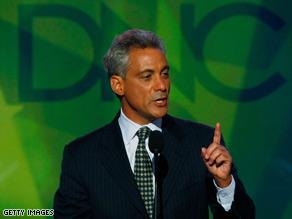
I could have told you Rep. Rahm Emanuel would be Chief of Staff... this is no big shocker to Chez Copa, CNN.

Emanuel pick gets mixed reaction

  • Story Highlights
  • Rep. Rahm Emanuel has a reputation as a tough political infighter
  • Boehner leader calls Emanuel an "ironic choice" for Obama
  • Reid's communications adviser says Rahm is a "brilliant strategic thinker"
  • Political analyst Gergen says they're "setting up a good cop/bad cop routine"

(CNN) -- President-elect Barack Obama's first major appointment received mixed reaction from Democrats and Republicans.

Rep. Rahm Emanuel on Thursday accepted Obama's offer to be White House chief of staff.

The Office of the Chief of Staff oversees and coordinates activities and communication among various departments of the administration. It is considered one of the top positions in Washington.

Some party leaders hailed Obama's pick, but others expressed concern that Emanuel would widen Washington's partisan divide. Watch what Emanuel says about being considered for the job

Jim Manley, the senior communications adviser for Senate Majority Leader Harry Reid, said Emanuel is "an excellent choice."

"Rahm knows the Hill, and he knows the White House. He is a brilliant strategic thinker and someone who knows how to get things done."

Manley said allegations that Emanuel is a true partisan are "ridiculous."

"Rahm understands politics is the art of compromise. He's got a deeply held set of views, but he also understands to get things done you have to compromise," he said.

But House Minority Leader John Boehner questioned Obama's selection.

"This is an ironic choice for a president-elect who has promised to change Washington, make politics more civil and govern from the center," he said in a statement.

A senior Democratic congressional aide also shook his head at the notion of Emanuel becoming the gatekeeper for Obama. The aide said that Emanuel's abrasive approach is "off-putting" and that his style runs counter to Obama's promise of a post-partisan administration.

"It contradicts what is his stated style goal of governance," the aide said.

In his statement accepting the position, Emanuel directly addressed Republicans who might have concerns with his appointment.

"We often disagree, but I respect their motives. Now is a time for unity, and Mr. President-elect, I will do everything in my power to help you stitch together the frayed fabric of our politics and help summon Americans of both parties to unite in common purpose," he said.

Emanuel, who has a reputation as a tough political infighter, is credited with helping Democrats take control of the House in 2006.

The Chicago politician was elected to the House in 2002 and is the fourth highest-ranking member of the chamber's Democratic leadership. He worked on President Clinton's first presidential campaign and served as a White House adviser to Clinton. VideoWatch more on Rahm Emanuel »

Emanuel choked up as he said how glad he is his parents are alive to see him become chief of staff for the first African-American president.

Democratic Sen. Chris Dodd said he thinks Emanuel is a "great choice."

"I know that he and Barack Obama have a very good relationship going back a long time. So it touches all of the critical elements, it seems to me, in beginning that kind of transition we'd like to have. So I think it's a great choice, and I think the president-elect will be well-served with Rahm Emanuel," he said.

Republican Lindsey Graham sided with Dodd and called Emanuel a "wise choice."

"Rahm knows Capitol Hill and has great political skills. He can be a tough partisan but also understands the need to work together. He is well-suited for the position of White House chief of staff," the South Carolina senator said.

Graham said he and Emanuel worked together during the presidential debate negotiations, and "when we hit a rough spot, he always looked for a path forward."

Rep. John Larson, vice chairman of the House Democratic Caucus, said he looked forward to working with Emanuel.

"I would first like to congratulate my colleague and friend Rahm Emanuel on his new position in the Obama administration. I know the Obama administration will be well-served by his skills and acumen. I look forward to working with him on the president's agenda for the country," he said in a statement.

David Gergen, a CNN senior political analyst who has worked in five administrations, said the contrasting styles between Obama and Emanuel could help the new president get things done in Washington.

"They are obviously setting up a good cop/bad cop routine in the White House. ... Barack Obama can be the good guy," Gergen said.

At a news conference Friday, Obama is expected to take questions and talk about his first steps as president-elect.


Thursday, October 16, 2008

You, Ma'am, Are No Margaret Thatcher

Take that, bitch!

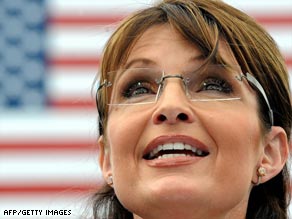
Europe mocks 'half-baked Alaskan' Palin

LONDON, England (CNN) -- There's no doubt about it. The European media has given Sarah Palin a hard time.
One European newspaper called the idea of a Palin presidency a "half-baked Alaskan nightmare."

One European newspaper called the idea of a Palin presidency a "half-baked Alaskan nightmare."

Things started quite well, with the curiosity factor. To many Europeans there is something exotic about snowy Alaska. Viewers and readers were intrigued by the shots of the outdoorswoman with her eyes squinting fixed along a gun barrel, the thought of a vice president who had once been a beauty queen.

Columnists were approving that here, for once, was a politician in the higher reaches who probably actually knew the price of a loaf and a pint of milk. Women writers in particular responded warmly to her joke about the difference between a pitbull and a hockey mom --"Lipstick."

But soon the carping began, and it was not confined to what U.S. rightists like to dismiss as the "liberal media elite."

We were, the Irish Times warned, "just a heartbeat away from the biggest half-baked Alaskan nightmare." Britain's Financial Times said his selection of vice president raised serious questions about John McCain's judgment and added: "The Palin appointment is yet more proof of the way that abortion still dominates American politics."

Prominence was given to an onslaught on Palin's environmental and animal rights record by veteran ex-film star Brigitte Bardot. Spain's left wing El Pais described Palin as "a figure who comes from the America that is farthest removed from and incomprehensible to the European spectator."

Since then the scorn has been constant, the jokes unrelenting, the YouTube exposure devastating. But let us dispel one bit of nonsense from the start. It is nothing to do with Sarah Palin being of the feminine gender.Sound Off: Is it fair for Europeans to criticize Sarah Palin?

Europeans have been astonished that America has never had a woman president. After all we in Britain elected the redoubtable Margaret Thatcher three times as prime minister. Norway did the same with Gro Harlem Brundtland. Germany has a female chancellor, Angela Merkel, even if she does tend to underline the remark I once heard from a British Ambassador: "A German joke is no laughing matter."

Nicolas Sarkozy's socialist challenger for the French presidency was the elegant Segolene Royal.

When Sarah Palin first became McCain's running mate there were even headlines in some British media suggesting that America had found its own Margaret Thatcher.

That certainly was overdoing it. So much so that after 20 years close up reporting on the original I can't resist the temptation to paraphrase Lloyd Bentsen's comment when Dan Quayle unwisely compared himself to John F. Kennedy. "I've interviewed Margaret Thatcher, Governor Palin and I can tell you that you are no Margaret Thatcher."

No, the problem for Sarah Palin in terms of her acceptance in Europe has been the deep wave of Obamamania that had already swept through the European media before her appointment, the self-inflicted wounds of her early media appearances and the apparent box-ticking cynicism of her choice.

That was summed up for some by the appearance of those women at McCain rallies wearing T-shirts emblazoned "Small Town Gun-Totin Christians for McCain."

For Europeans, who were alienated during George W. Bush's first four years by a president who showed little interest in their continent and patently cared nothing for the opinions of its leaders, the turning point probably came with the appearance on the Katie Couric show when Palin confessed to not having had a passport until 2006.

Europeans are appalled at the thought that someone who wants to be vice president of the most powerful nation on earth had so little interest in the rest of a world which is so vitally affected by the decisions of the man, or woman, in the White House. iReport: Why are the 2008 U.S. Elections important to you and your home country?

And they are not much impressed by explanations that her parents did not have the money to send her on a fact-finding tour of the world as a student. Anybody with the money to own an SUV, hunt moose and drive a snowmobile has the money to travel.

It was the American Mark Twain who reminded us all that "travel is fatal to prejudice, bigotry and narrow-mindedness." If Sarah Palin wanted to be loved in Europe she should have got about a bit.


Wednesday, October 1, 2008

Sarah Palin: The Dan Qualye of Our Generation

Palin, A Journalism Major, Can't Name A News Source She Reads

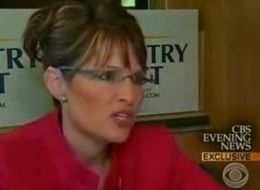
Sarah Palin said she does not support the morning after pill as a form of contraception, strongly implied that homosexuality was a choice, and could not name a single source of news that she turns to for information, in yet another installment of her interview series with Katie Couric.

Appearing on CBS Evening News, the Alaska Governor seemed calmer than she had been in previous sit downs. But while she only occasionally provided the type of befuddled responses that had even conservatives scratching their heads, her interview was nevertheless shaky.

Asked what newspapers and magazines she reads, Palin - a journalism major in college - could not name one publication.

"I've read most of them, again with a great appreciation for the press, for the media," she said at first. Couric responded, "What, specifically?"

"Um, all of them, any of them that have been in front of me all these years."

"Can you name a few?"

"I have a vast variety of source where we get our news," Palin said. "Alaska isn't a foreign country, where it's kind of suggested, 'wow, how could you keep in touch with what the rest of Washington, D.C., may be thinking when you live up there in Alaska?' Believe me, Alaska is like a microcosm of America."

Later, when pressed on a variety of cultural issues, Palin provided red meat for religious conservatives. But her answers seemed to fall on the far edge of mainstream political thought. She said she was "unapologetically" pro-life when asked if she opposed abortion even for a 15-year-old raped by her father.

"[I would] counsel that person to choose life despite the horrific, horrific circumstances," she said, before moderating her position a bit: "If you're asking, though, kind of foundationally here, should anyone end up in jail for having an ... abortion, absolutely not. That's nothing I would ever support."

Asked whether she believed that the morning after pill should be outlawed, Palin did not directly address the question, saying only: "Personally, and this isn't a McCain-Palin policy, I would not choose to participate in that kind of contraception."

And quizzed about her position on gay-rights, Palin cited a homosexual friend whom she is close with before noting that she "made a choice" about her sexuality.

"I have," she said, "one of my absolute best friends for the last 30 years who happens to be gay and I love her dearly. And she is not my gay friend. She is one of my best friends who happens to have made a choice that isn't a choice that I would have made."

These positions may, in the long run, endear Palin even more to her conservative following. But combined with her failure to name a source of news she turns to, they are also bound to have people buzzing up through Thursday night's vice presidential debate.

Watch the interview below!


Sunday, September 21, 2008

This Just In: All Bullies Ordered to Back Off Palin in the Schoolyard

What a bunch of bullshit. Palin, why don't you grow a pair and step up. If you really want to be Vice President of the most powerful country in the world, perhaps you should have a little debate experience... and if you don't, then perhaps this job isn't for you.

September 21, 2008

Pact on Debates Will Let McCain and Obama Spar

The Obama and McCain campaigns have agreed to an unusual free-flowing format for the three televised presidential debates, which begin Friday, but the McCain camp fought for and won a much more structured approach for the questioning at the vice-presidential debate, advisers to both campaigns said Saturday.

At the insistence of the McCain campaign, the Oct. 2 debate between the Republican nominee for vice president, Gov. Sarah Palin, and her Democratic rival, Senator Joseph R. Biden Jr., will have shorter question-and-answer segments than those for the presidential nominees, the advisers said. There will also be much less opportunity for free-wheeling, direct exchanges between the running mates.

McCain advisers said they had been concerned that a loose format could leave Ms. Palin, a relatively inexperienced debater, at a disadvantage and largely on the defensive.

The wrangling was chiefly between the McCain-Palin camp and the nonpartisan Commission on Presidential Debates, which is sponsoring the forums.

Commission members wanted a relaxed format that included time for unpredictable questioning and challenges between the two vice-presidential candidates. On Wednesday, the commission unanimously rejected a proposal sought by advisers to Ms. Palin and Senator John McCain of Arizona, the Republican presidential nominee, to have the moderator ask questions and the candidates answer, with no time for unfettered exchanges. Advisers to Mr. Biden say they were comfortable with either format.

Both campaigns see the four debates as pivotal moments in a presidential race that is not only extraordinarily close but also drawing intense interest from voters; roughly 40 million viewers watched the major speeches at the two parties’ conventions. The upheaval in the financial markets has recast the race in recent days, moreover, which both sides believe will only heighten attention for the debates.

A commission member said that the new agreement on the vice-presidential debate was reached late Saturday morning. It calls for shorter blocks of candidate statements and open discussion than at the presidential debates.

McCain advisers said they were only somewhat concerned about Ms. Palin’s debating skills compared with those of Mr. Biden, who has served six terms in the Senate, or about his chances of tripping her up. Instead, they say, they wanted Ms. Palin to have opportunities to present Mr. McCain’s positions, rather than spending time talking about her experience or playing defense.

While the debates between presidential nominees are traditionally the main events in the fall election season, the public interest in Ms. Palin has proved extraordinary, and a large audience is expected for her national debate debut.

Indeed, both the McCain and Obama campaigns have similar concerns about the vice-presidential matchup in St. Louis: that Ms. Palin, of Alaska, as a new player in national politics, or Mr. Biden, of Delaware, as a loquacious and gaffe-prone speaker, could commit a momentum-changing misstep in their debate.

The negotiations for the three 90-minute debates between the men at the top of the tickets were largely free of brinksmanship. Neither side threatened to pull out, and concerns about camera angles and stagecraft were minor.

Senator Barack Obama of Illinois, the Democratic nominee for president, and Mr. McCain did not intercede personally to settle any disputes. They agreed to one substantive change to the format originally proposed by the debate commission, giving them two minutes apiece to make a statement at the beginning of each segment on a new topic.

Mr. Obama successfully sought to flip the proposed topics for the first and third debates, so foreign policy is now coming first and economic and other domestic issues come last. There is a second debate, in the format of a town hall meeting, in which the candidates will sit on director’s chairs and take questions from the audience and Internet users on any topic.

The debate commission had proposed that the first debate be on economic issues and the third on foreign policy — in part, people involved in the process said, because the first debate is usually the most watched, and many voters rank the economy as their top concern.

Mr. Obama wanted foreign policy first to show viewers that he could provide depth, strength and intelligence on those issues, his advisers said, given that Mr. McCain consistently wins higher ratings in opinion polls as a potential commander in chief.

Mr. Obama wanted domestic issues to come last; advisers said that they believed even before the start of the financial crisis that the election was most likely to turn on the state of the economy and that he wanted the final televised exchange to focus on those concerns. He has argued that Mr. McCain would continue the economic policies of President Bush.

Mr. McCain also wanted foreign policy topics to come first in the debates, his aides said, in the hope of capitalizing on his positive reputation on national security issues across party lines.

He wanted limits on the original format for the first and third debates, which had been nine topics with nine minutes of free-flowing debate on each one. Mr. Obama went along, though his aides did insist that at least several minutes of open-ended debate occur in each block of questioning, because they believe he does well in that format.

Now the candidates will be asked a question, each will give an answer of two minutes or less, and then they will mix it up for five additional minutes before moving on to the next question in the same format.

Obama aides also agreed to use lecterns at the first event, which Mr. McCain preferred; at the third debate, the two men will be seated at a round table, in the 10 o’clock and 2 o’clock positions, with the moderator at 6 o’clock.

McCain aides said that they were conscious of the fact that Mr. McCain has a prominent scar on one side of his face, and that they could not predict how prominent it would appear with the camera angles, lighting and make-up.

The debate formats were negotiated by Senator Lindsey Graham, Republican of South Carolina, representing the McCain campaign, and Representative Rahm Emanuel, Democrat of Illinois, for the Obama camp. A handful of aides from both camps were also involved, hammering out issues between themselves and then holding conference calls with members of the commission to reach final agreements, people involved in the process said.

Mr. Obama plans to begin debate camp on Tuesday with a tight circle of advisers at a site in the Tampa Bay area of Florida, his aides say, with a prominent Democratic lawyer, Greg Craig, playing the part of Mr. McCain in mock debates.

The Obama campaign has been studying Mr. McCain’s debate performances from the Republican primary as well as in his 2000 race for president. Each debate has been rated and scored, with briefing points and highlights sent to Mr. Obama.

Mr. Obama’s advisers have been studying in particular Mr. McCain’s temperament and mood and looking for potential flash points of anger.

Mr. McCain, his advisers say, has yet to spend much time watching the dozens of primary debate performances of Mr. Obama over the last two years. But they said that a small staff of aides had been reviewing them and that Mr. McCain would see some highlights next week.

McCain aides refused to say when his debate camp would be or where, or who was playing Mr. Obama or Mr. Biden. (Gov. Jennifer M. Granholm, Democrat of Michigan, is playing Ms. Palin for Mr. Biden’s preparations.)

Mr. Obama plans to sequester himself and a few advisers at his debate camp. The attendance is limited to a small group of foreign policy advisers, each rotating in for separate sessions with Mr. Obama and Mr. Craig.

The choice of Florida, particularly the politically critical region near Tampa, was selected with a dual purpose in mind. While Mr. Obama will have few public events from Tuesday through Friday, aides said, his presence could draw considerable local news media attention in a state where he hopes to fiercely challenge Mr. McCain.

While the intense portion of debate training begins on Tuesday, Mr. Obama has been preparing for weeks, in part by drawing upon his experience debating Senator Hillary Rodham Clinton of New York in the Democratic primaries. His aides have been studying those debate performances to address one of his biggest shortcomings: his ability to deliver a tight answer. Already, his campaign is trying to diminish expectations for Mr. Obama’s performance.

“Despite the fact that we got the chance to do this a lot during the primaries, these debates are not by any stretch of the imagination his strong suit,” said Robert Gibbs, a senior strategist to Mr. Obama. “He likes to talk about a problem, give some examples that addresses some solutions and oftentimes that doesn’t fit into the moderator’s allotted time.”

The campaigns had no say over the choice of moderators — Jim Lehrer of PBS, Tom Brokaw of NBC and Bob Schieffer of CBS for the presidential debates, and Gwen Ifill of PBS for the vice-presidential debate.

“Everything matters and issues can always come up, such as the size of podiums — like for Carter and Ford in 1976 — to the timer lights if the candidate doesn’t like them,” said Tad Devine, a Democratic strategist who advised Al Gore in 2000 and John Kerry in 2004. “There hasn’t really been a ‘debate about the debates’ this year, but that can change in a minute.”

Jeff Zeleny contributed reporting from Miami.

Friday, July 25, 2008

with a clipboard and an air of confidence

WE'RE THE SOURCE!!!

Politico:Bob Novak's victim
Washington Post: Man Hit by Novak Has Hurt Shoulder but Is 'Doing Fine'
The Examiner:Novak's Victim Speaks! "Bob Novak is the one that hit me?!? ... That makes it a great story!"

Associated Press:
Man hit by columnist Robert Novak recovering

WASHINGTON (AP) - The homeless man who was struck by a car driven by syndicated columnist Robert Novak says he's surprised to hear the prominent journalist was the driver who hit him.

Don Clifford Liljenquist asked a reporter from WMAL Radio repeatedly whether Novak was the person who hit him. The 86-year-old seemed amused. He said, "Well I think that makes it a great story!"

Liljenquist says his shoulder was dislocated when he was struck Wednesday. He says doctors reset his shoulder and he's "doing fine."

Witnesses say Novak was driving a Chevrolet Corvette near K Street when he hit a pedestrian who rolled up onto the hood of the car. Novak kept driving until a bicyclist stopped him.
Novak has said he didn't know he hit anyone. He was given a $50 traffic citation.

(Copyright 2008 by The Associated Press. All Rights Reserved.)